3 wheel vs 4 wheel golf push cart
For most golfers and rental fleets, a 4-wheel golf push cart is the more stable choice: four contact points keep the bag level across slopes and side-hills, and most current models fold into a compact upright block. A 3-wheel push cart is lighter, turns more sharply and usually costs less, which is why it still leads price-driven retail shelves.
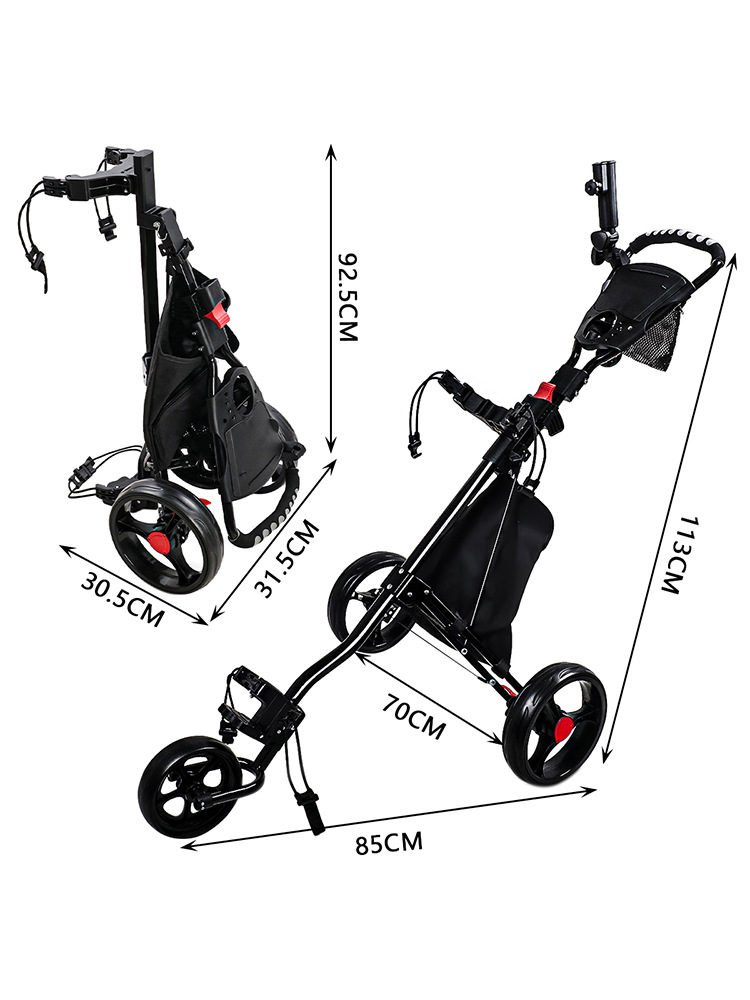
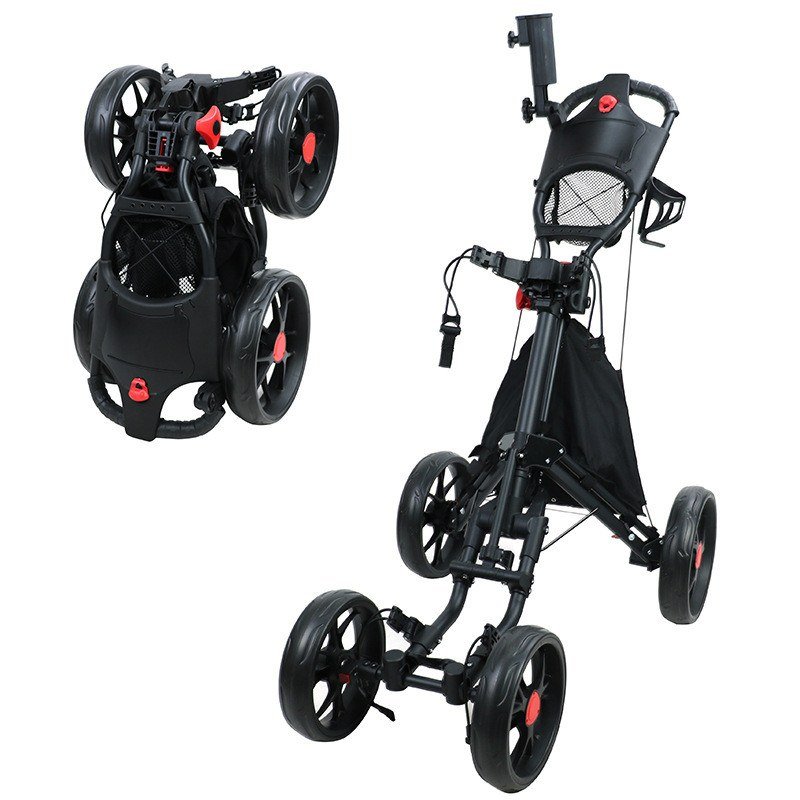
Side-by-side comparison
| 3-wheel push cart | 4-wheel push cart | |
|---|---|---|
| Stability on slopes | Pivots on one front wheel; can lean on side-hills with a heavy bag | Four contact points keep the bag level — the clearest advantage |
| Weight | Lighter — one less wheel and a simpler front assembly | Heavier, though modern alloy frames narrow the gap |
| Turning | Sharper, pivots almost in place | Wider arc unless the front wheels swivel |
| Folded shape | Often folds flat but wide | Wheels fold inward into a compact block that stands upright |
| Cost position | Lower — fewer parts, simpler tooling | Higher, with more hardware and swivel mechanisms |
| Best for | Price-led retail, flatter courses, lightweight preference | Rental fleets, hilly courses, premium retail positioning |
How buyers should actually decide
The wheel count is rarely the real decision. These four questions decide more of the outcome:
- Terrain. Genuinely hilly courses push the answer to 4-wheel almost every time; flat parkland courses keep 3-wheel viable.
- Storage and transport. A cart that folds into a stackable block matters more to a course storing 40 units than to a golfer with one trunk.
- Who lifts it. Rental fleets are lifted by staff dozens of times a day; retail carts are lifted by one owner twice a round.
- Price band. Decide the retail or rental price band first, then choose the wheel count that fits the build cost — not the reverse.
For private-label programs: we develop both configurations under the same quality-control process, so the choice is a positioning decision rather than a supply constraint. Structures are factory-original with disclosed ownership or independently developed, with patent review before mass production.
Frequently asked questions
Is a 3 wheel or 4 wheel golf push cart better?
Neither is better in the abstract. A 4-wheel cart is more stable on slopes and folds into a compact upright block; a 3-wheel cart is lighter, turns more sharply and costs less. Rental fleets on hilly courses generally choose 4-wheel, while price-led retail programs still sell 3-wheel in volume.
Which is more stable, a 3 wheel or 4 wheel push cart?
The 4-wheel cart. With four contact points the frame resists tipping across a slope, while a 3-wheel cart pivots around its single front wheel and can lean on side-hills, especially with a heavy staff-style bag loaded high.
Does a 3 wheel golf push cart fold smaller than a 4 wheel?
Not necessarily. Older 3-wheel designs fold flat but wide, while current 4-wheel carts fold the wheels inward into a block. Our 4-wheel reference sample folds to roughly 30 × 30 × 60 cm from an open size of about 45 × 90 × 110 cm.
What is the difference between a golf push cart and a pull cart?
A push cart rolls in front of you on three or four wheels and takes less effort over 18 holes. A pull cart trails behind on two wheels and is lighter, simpler and cheaper. Courses often buy 2-wheel pull carts for rental durability.
Are golf push carts worth it?
For walking golfers, yes — the load comes off the shoulders for four to five hours. For a course, a rental fleet earns revenue for years when specified with sealed bearings, puncture-free wheels and replaceable wear parts.